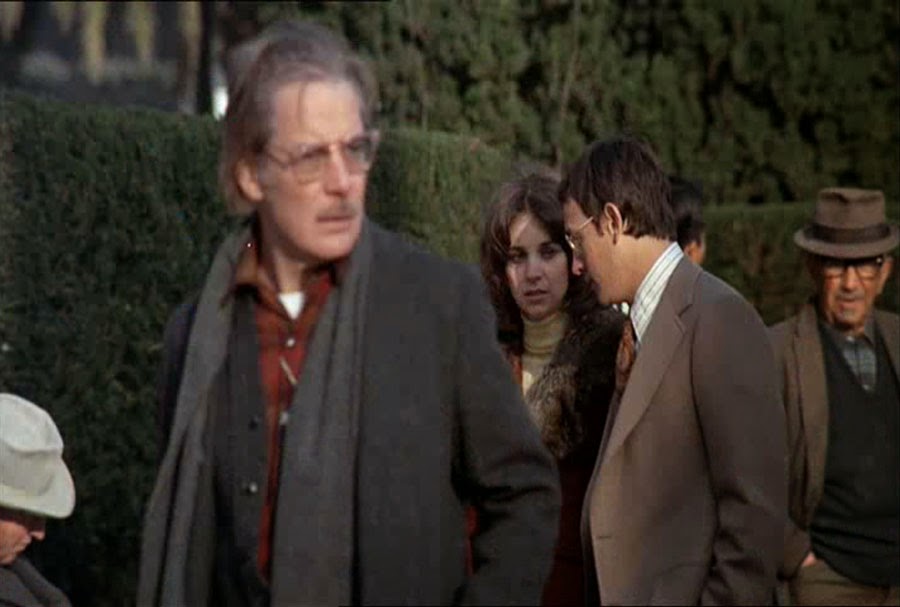
Saturday, 14 June 2014

Orientation

Assignment filter 


Assignment structure 


Saturday, 7 June 2014

Final words

DFP course was a really long journey which revealed me how complex the film medium is. After it, I can say that I am able to better understand what the film-making process is. The easiest part of the course was to build an atmosphere for me. On the other hand, it is the story structure for what I was mostly criticized. Thus, I need to be more focused to tell the story more "clearly", lets says better structured. Myself study in future will be training to tell the story by uninflected shots (Eisenstein's theory of montage) and perhaps I will choose the Screen writing course to have more knowledge about story structure.

David Mamet, On Directing Film

It is a great book which helped me to understand Eisenstein's montage theory. The book is a conversation with students and the process when they are building story by images is amazing.

Some notes:
Tell the story by cuts - through a juxtaposition of images that are basically uninflected (page 2). 

The best image is an uninflected image (Eisenstein) - A shot of a teacup. A shot of a spoon. A shot of a pork. A shot of a door. Let the cut tell the story. Because otherwise you have not got dramatic action (page 2).

What does the protagonist want? It is this journey that is going to move the story forward. What does the protagonist want? What does he or she do to get it - that's what keeps the audience in their seats. If you don't have that, you have to trick the audience into paying attention (page 11).

Always do things the least interesting way, and you make better movie (page 20).

In House of Games, when the two guys are fighting about a gun in the doorway and we cut away to a shot of the sidekick, the professor character, looking on, then you hear the gunshot. That is pretty good film-making (page 32).

In the Uses of Enchantment, Bruno Bettelheim says of fairly tales the same thing Alfred Hitchcock said about thrillers: that the less the hero of the play is inflected, identified, and characterized, the more we will endow him with our own internal meaning - the more we will identify with him - which is to say the more we will be assured that we are that hero (page 38).

The job of the film director is to tell the story through the juxtaposition of uninfected images - because that is the essential nature of the medium (page 60).

Audience - They want to see what's happening next (page 62). Interest in a film comes from this: the desire to find out what happens next (page 63).

The way to shoot the car crash is not to stick a guy in the middle of the street and run over him and keep the camera on. The way to shoot the car crash is to shoot the pedestrian walking across the street, shoot the shot of onlooker whose head turns, shoot the shot of a man inside the car who looks up, shoot shot of the guy's foot coming down on the brake pedal, and shoot the shot underneath the car with the set of legs lying at strange angle (with thanks to Pudovkin, for the above). Cut them together , and the audience gets the idea: accident (page 76).

Monday, 19 May 2014

Assigment 4 Re-edited

My tutor recommended me to re-edit the final assignment. His critique was mainly about the narrative and wrong English: I did have some trouble following your narrative and your English subtitles though. Robert also proposed me his structure which I could follow and make the story more clear.
Here is the result:


Robert's comment: It's 100% better.  Quite professional, flows well and you've put the pieces together coherently.  Only a few English errors (during) but these are minor. Well done.

Monday, 17 February 2014

Assignment 4 Constructing a narrative

PDF files: 
Report with preparation notes and critique: Assignment_4_Notes.pdf
Tutor report: Tutor_Report_Assignment4.pdf


some photographs


-

Monday, 28 October 2013

A way to a documentary film by Rudolf Adler

some notions from that book:

A documentarist must know perfectly the subject matter - seeing, experience. (Robert Flaherty - Nanook of the North 1922). The experience is very important. The author's fascination of the subject matter is somehow projected into a form of a documentary. The documentary should evoke the same feeling in audience. It is an essential assumption for an imagination result which should call out catharsis in audience mind (edification, exoneration, relief).

Once an author deeply knows ambient (background) he can structure a theme because the subject matter - seeing reality is not a theme itself. In general, a theme is an author's idea which is formulated on a base of particular observation and experience of subject matter from an artistic point of view. (Robert Flaherty's theme in general: Humanistic theme of human dignity, sociability, solidarity and greatness. Luis Bunuel: His general theme was about human abasement, human dignity humiliation by physical or spiritual affliction etc.)

Both Flaherty and Bunuel fulfil the cathartic process through a strong aesthetic and emotional experience. Besides positive, enjoyable and noble things of the subject matter there should also be those dark, tragic and negative sides of life but it does not mean that the art is negative. (Aristotle and catharsis).

A thematic limitation of art creation within an area of positive life values with a recall on their noble function is a nonsense because the creation loses its philosophy depth and life trueness.

If the theme is an expression of an author's idea in general than the subject is a content concretization.


Sunday, 6 October 2013

Exercise: De-edit a sequence - reconnected shots

I was successful to shorten the cuts mainly in shots where no dialogue was and where I was able to play with non-diegetic or off screen sound.


Shots cut down to the absolute bare minimum: I noticed some of them lost their tempo even the cut works well. Some shots have got feeling that something is missing. I was happy when some information was cut out and in the end it was not missing, e.g. Harry gets a coffee. I was not able to cut down some shots because there was a dialogue.

Answer:
1. The sequence still conveys the meaning. It is true that it looks somehow shorten and that something is missing. The flow of the story was damaged and there is a feeling that something must be repaired.

2. The feeling here is that something is missing like tempo and flow of story. The cutting is really important to tell the story to be believable. In my shortened version I cut down 30 second from original which is 4 minutes and 30 s long.

3. I think the feeling did not affected the meaning, still we can feel that Harry is an introvert and professional in his work. The mystery atmosphere is still there.

I did not uploaded the sequence because you-tube blocked some of previous sequences due to the rights.

Wednesday, 18 September 2013

De-edit a sequence: The Conversation - Motivation for each cut


the first cut: we get all information and the feeling is that Harry is entering the building on the right CUT and we are with him in a lift.


the second cut: Harry is leaving the lift - space of a floor is introduced. A while before a cut we hear "Hi Harry" CUT and we see Harry is taking off his macintosh. The cut works even we saw Harry's back and after the CUT he is standing in front of camera! Motivation: Off Screen Sound ("Hi Harry")


the third: Harry is turning on the equipment and we hear "Listen" CUT and we see his assistant who is reading a part of an article.


the fourth: The assistant is continuing in reading and when he is finishing a movement of scratching his face CUT we see a hand searching photographs. It looks that the CUT works well because there was unfinished movement in the cut before. We see Harry is touching something by his right hand. The scratching movement is not motivation because I tried to cut before the assistant is scratching his face and the CUT worked also. The motivation is maybe a rhythm and we continue to see something what was motivated before. Harry is  looking on photographs.


the fifth: initially I did no notice it but across the CUT we hear "listen this" says assistant CUT and we see Harry is looking down on the photographs. I tried to shorten / prolong the cut but it did not work! It was disturbing cut - there is the off screen sound motivation.


 the sixth: still we can hear the assistant - it is the motivation to make a CUT to see him as he is still reading.


the seventh: The assistant finished the article. After when he rose up his eyes from magazine to Harry, he is looking off screen at Harry and immediately is making a grimace and there is a CUT to Harry's hands searching photographs. Motivation: looking of screen.  I tried to cut after the assistant rose up his eyes and it worked only when the cut was made before the grimace.


the eighth:


the ninth: Off screen motivation - Harry is looking at the photograph - ("Do you want some coffee?" said the assistant in the second frame)


the tenth: Sound off screen - there is a sound of assistant's steps


the eleventh: Stanley is waiting for an answer from Harry - it looks like it was motivation for cut here. Before Stanley started to pour coffee he was looking at Harry but the cut was prolonged. I tried to cut when Stanley is looking at Harry and it worked.


the twelfth: Off Screen Action


the thirteenth: Rhythm 


the fourteenth: Off Screen - Stanley is looking in Harry's position.


the fifteenth: Off screen action, Harry is waiting on beep sound mark on tape to synchronize the three recorders.


the sixteenth:


the seventeenth: Off screen looking


the eighteenth: we can hear the recorded audio and the CUT is motivated by off screen action as Harry is tuning the equipment which controls the three audio players.


the nineteenth: Harry turned off the audio track A and B and tuned only audio track C (City Paris unit) the CUT is motivated by the action.


the twentieth: motivation is probably rhythm because we can see the unit recording the audio and CUT we can see a couple which is recorded.


the twenty-first: we can hear that the recorded audio is loosing its quality CUT and we can see Harry at the desk. I like where the editor made the cut. The couple are hidden behind a figure. The interesting thing is also where the CUT begins - Harry has his eyes closed.


the twenty-second: Cutting on the movement, As Harry is putting his hands on equipment there is CUT to shot which is finishing the movement.


the twenty-third: Harry turned off the track C and tuned up the track A and the CUT is showing us a man who is carrying the unit A - shopping bag.


the twenty-fourth: there is same pattern as it was at the unit C. Harry - Unit - The couple.


the twenty-fifth: the last shot is ending at Harry and CUT we are back at his work.


the twenty-sixth: Harry is looking on the recorder


the twenty-seventh: the motivation is the dialogue


the twenty-eighth: the sound is getting worse, the camera moved from A to B recorder.


the twenty-ninth: the motivation is to show the unit B


the thirtieth: from unit B to the equipment


the thirtieth-first: from the equipment to the photograph


the thirtieth-second: from the photograph to Harry who is looking at it.


the thirtieth-third:  Harry is looking of screen at the recorders


the thirtieth-fourth: Harry is looking off screen at the recorders and after


the thirtieth-fifth: he is looking off screen at loudspeaker


the thirtieth-sixth: we see wide shot and ...........


the thirtieth-seventh: we are going to another sequence